
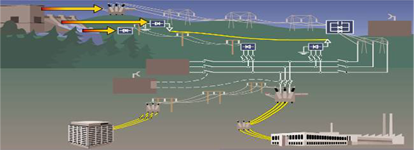
Power factor is the measurement of how effectively electrical power is being used. The higher the power factor, the more efficient the plant…all the way back to the generator.
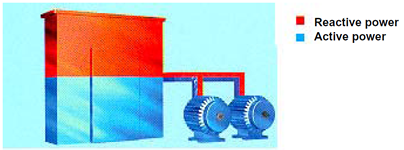
- Active (working) power which performs the useful work
- Reactive (non-working) power which creates the magnetic fields for inductive devices
- Apparent Power (kVA) = Active power (kW) + Reactive power (kVAr)
Loads in electrical plants draws 2 types of power; active power, which is measured in the unit of kW. And reactive power, which is measured in kVAR.
Active power is the component which is used to perform useful work, which is converted into other forms of energy such as mechanical energy when the electrical motor turns. Reactive power, sometimes referred to as non-working power, is the component that creates and maintain electrical and magnetic fields of inductive devices.
Therefore, even though reactive power is not directly contributing as a measurement of work performed (by a motor as an example), reactive power is still important for the motor to work. Apparent power, is a quadratic summation of active and reactive power, and is measured in kVA.
Therefore, when a motor runs, it is drawing both active and reactive power from the source to perform its function.
Low Power Factor is like…
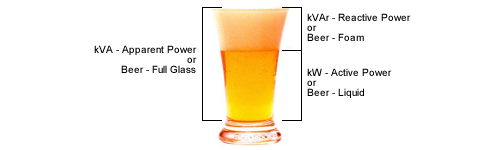
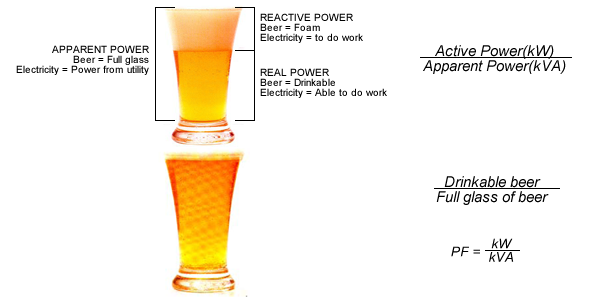
A simple analogy which can illustrate the concept of active power, reactive power and apparent power is a glass of beer. Imagine that you bought a full glass of beer and the full glass of beer is seen as apparent power.
Now in the glass, there is the portion that is liquid, the beer itself. This is the part which fills you up. That could be described as the active power. On the top of the liquid, is the region of foam.
This part does not fill you up, but takes up a portion of the glass no less. This could be describe as reactive power. So when you have low power factor in your factory or plant, it will be like you are paying for a glass of beer which has lots of foam and little beer itself. Not a good preposition.
Power factor can also be represented in a graphical sense. The active power is on the horizontal axis and the vertical axis is the reactive power. The diagonal line therefore represents the quadratic summation of the active power and the reactive power.
Power factor is then the cos angle between the active power and the apparent power. As you can observe, as the cos angle becomes smaller, the apparent power approaches the value of active power.
This means improvement in the power factor. Another way of viewing power factor is that PF is that it is a ratio of active power (kW) versus apparent power (kVA).
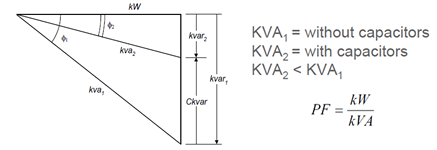
- kVA: Total Power
- kW: Working Power
- kVAr: Reactive Power needed to generate magnetic fields for inductive loads such as motors
- Power Factor: The relationship of real power (kW) and total power (kVA) consumed
So back to the beer analogy of power factor, this is what a system with good power factor looks like in comparison to one which has poor power factor.
So which glass would you choose? What power factor would you want your plant to be running on?
But here are the real world reasons why having a high power factor is important.
The impacts can be viewed from the point of view of an utility as well as an end-user.
As a utility or a generation of power, if your end-user is not improving their power factor, your investments will have to cater for the generation, transmission and distribution of both active and reactive power. This means larger equipment like transformers and cables.
This higher demand of power has the potential of pushing the limit if the system to its limits thereby, causing “brown-outs”.
As an end-user, the power providers will transfer the cost of their investment in having to install larger equipment in the form of higher tariffs and penalties.
Why improve…
- The lower the power factor, the more reactive power the Utilities need to provide. This can result in:
- Larger equipment (i.e. poles and wires) required to supply power
- System capacity problems leading to ‘brown-outs’
- Higher operating costs due to maximum demand charges –kVAr (kVA) tariff and energy loss
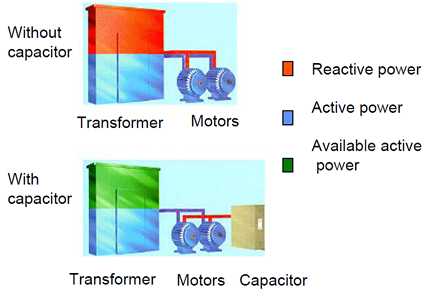
Capacitors produce reactive power through its charge and discharge cycles when connected to alternating voltage.
By installing capacitors, network capacities can be freed.
This means that power transformers can operate at a reduced capacity, allowing the option either more loads to be connected to it. Or by operating under less stress, the service life of the transformer can be prolonged.
New transformers can be sized for a lower apparent, reducing capital investments
By increasing the power factor, cables with a small sectional area can be used.